Tuesday, 8 June 2010

Funding

http://news.bbc.co.uk/1/hi/health/8711977.stm

It's been a while since I posted, I realise this, and I apologise everyone! Really, I do! Life kind of ran away from me for a little while, I've faced a pretty nasty situation at work and needed time to reflect on me, my opinions, whether I'm strong enough to deal with them, and how I'll move forward from them. I knew physical intervention was part of my job, I knew I'd need it at some point....I just didn't think I'd have to use it alone. My view of my colleagues changed, and my view of myself has changed.

Anyway - I read the above article this morning while having my tea and toast, at the time it didn't really register (tired brain!), but while in art therapy I found myself looking at the clients and thinking back to it. There is still a stigma attached to mental health, it's still as confusing as ever.....the article gives an insight into why.

If you have a few minutes check it out! (I promise a longer post soon!)

Monday, 10 May 2010

Borderline Personality Disorder (BPD)

a video!

very touching and very emotional clip.....but worth a watch.

Tuesday, 27 April 2010

Schizophrenia


Today during the morning's de-briefing we had a talk from a behavioural therapist with regards to one of our client's mental health problem. He has Schizophrenia, this is not to be confused with Dissociative Identity Disorder (I'll cover this in another blogpost at some point). Schizophrenia is characterised by distortion of perception or reality. Approximately one in a hundred people will suffer at least one episode of acute Schizophrenia in their lifetime, statistically there is no real gender difference and the symptoms usually begin in early adulthood. Symptoms are usually divided into positive and negative symptoms because of their impact on diagnosis and treatment. Positive symptoms are those that appear to reflect an excess or distortion of normal functions. Negative symptoms are those that appear to reflect a diminution or loss of normal functions; usually when there is an absence of positive symptoms. Negative symptoms are difficult to evaluate because they are not as grossly abnormal as positives ones and may be caused by a variety of other factors as well.

The DSM-IV gives the diagnostic criteria for Schizophrenia as;
"Positive" Characteristics;
Two or more of the following present for a significant portion of time during a one month period or less if treated successfully;
1. Delusions; strong false beliefs that are still held despite overwhelming invalidating evidence;
- Paranoid/Persecution Delusion; believing people are "out to get" you.
- Delusions of reference; belief that environmental items appear directly related to you even though they are not, i.e. communications through the television
- Somatic Delusion; false beliefs about your body i.e. the belief that something foreign is inside your body.
- Delusions of grandeur; i.e. belief that you have special powers or abilities.
2. Hallucinations;
- Visual; seeing things that are not there, or that other people cannot see.
- Auditory; hearing things others cannot hear.
- Tactile; feeling things that other people do not feel.
- Olfactory; smelling things that other people cannot smell.
- Gustatory; tasting things that are not there.
3. Disorganised speech (derailment or incoherence); ongoing disjointed or rambling monologues in which the person appears to be speaking to themselves or imagined people/voices.
4. Grossly disorganised or catatonic behaviour; abnormal condition variously characterised by stupor, mania and either extreme ridigity or flexibility of the limbs.

"Negative Characteristics";
1. Alogia; decrease of speech fluency and productivity, usually seen as short replies to questions. Believed to be a reflection of blocked/slowing thoughts.
2. Affective Flattening; Reduction of emotional expression (including facial, tone of voice, eye contact), inability to interpret body language.
3. Avolition; reduction or difficulty in achieving goal-directed behaviour. Can be mistake for disinterest.

Cognitive Symptoms; difficulties with concentration and memory.
- Disorganised thinking
- Slow thinking
- Difficulty understanding
- Poor concentration
- Poor memory
- Difficulty expressing thoughts

Types of Schizophrenia;
1. Paranoid Schizophrenia; These people are very suspicious of others and often have grand schemes of persecution at the root of their behaviour patterns. Halluciations and delusions, are a prominent and common part of the illness. Thought disorder, disorganized behavior, and affective flattening are absent.
2. Disorganised Schizophrenia (Hebephrenic Schizophrenia); In this case people are verbally incoherent and may have moods and emotions that are not appropriate to the situation. Hallucinations are not usually present. Thought disorder and flat affect are present together.
3. Catatonic Schizophrenia; In this case, the person is extremely withdrawn, negative and isolated, and has marked psychomotor disturbances; the subject may be almost immobile or exhibit agitated, purposeless movement. The symptoms can also include catatonic stupor and waxy flexibility
4. Residual Schizophrenia - In this case the people are not suffering from delusions, hallucinations, or disorganized speech and behaviour, but lack motivation and interest in day-to-day living. Where positive symptoms are present at a low intensity only.
5. Schizoaffective disorder; These people have symptoms of schizophrenia as well as mood disorder such as major depression, bipolar mania, or mixed mania (explained below)
6. Undifferentiated Schizophrenia; Conditions meeting the general diagnostic criteria for schizophrenia but not conforming to any of the above subtypes, or exhibiting features of more than one of them, without a clear predominance. Psychotic symptoms are present but the criteria for paranoid, disorganized, or catatonic types have not been met.

Schizoaffective Disorder is characterised by recurring or simultaneously episodes of elevated or depressed mood, that alternate or occur together with distortions in perception. The DSM-IV-TR characterise this as;
-Delusions
-Hallucinations
-Disorganised speech (manifestation of formal thought disorder)
-Disorganised behaviour or catatonic behaviour
- Negative Symptoms i.e. avolition, anhedonia, social withdrawal, etc.
Usually two or more of the following symptoms are present for the majority of a one month period (dependant upon if the symptoms improved with treatment). However, if the delusions are judged to be "bizarre", or if the hallucinations consist of hearing one voice in a running commentary of the individuals actions, or if the individual hears two or more conversing voices; then only the Delusions criterion is needed for a diagnosis. At some time during this bout of illness, some or all of the following episodes would be present;
major depressive episode
manic episode
mixed episode
Usually these symptoms are not caused by drug abuse.

There are also two further subtypes of Schizoaffective Disorder that exist, these are;
1. Bipolar type; disturbance may include;

2. Major depressive episodes usually, but not always, also occur in the bipolar subtype, however they are not required for DSM-IV diagnosis.

3. Depressive type; The depressive type is noted when the disturbance includes major depressive episodes exclusively. This applies if major depressive episodes only (and no manic or mixed episodes) are part of the presentation.
So these are the types (and subtypes) of Schizophrenia; I'll cover drug induced Schizophrenia and treatments another day. For now, I'm going to chill infront of the television (The Story of Science is on BBC2 for all my fellow geeks) after my hectic day.

Peace out!

Friday, 16 April 2010

New Job Induction and Introduction

I have learned so much this week, it has been a mish mash of paperwork, legalities, vaccinations and meeting new people. On Monday I strolled into the security booth, every now and again checking that my car hadn't moved from it's place in the visitors car park through the booth windows. I was shaking, nerves really giving me an overhaul. I felt sick, anxious, excited and apprehensive. It's been a while since I actually worked in mental health and learning disabilities, and quite a few years since I worked in a secure unit. I signed the visitors book, and attached my visitors pass to my freshly ironed jeans, then stepped out of the other side of the booth, onto the other side of the fencing, the other side of the barrier, and into a new world. I followed the path along some of the newly built units, the whole place eerily silent, the sun beaming down, illuminating the greenery, giving the place a comforting appeal. I shielded my eyes from the sun and gave a nervous glance to the red brick building standing in the centre of the hospital grounds....the remnants of a long forgotten time, a time of pain, of anguish, of screams, confusion, hurt....the only reminder of the long gone "lunatic asylum", the long gone patients hidden from the judging society.

It took me a few moments to realise I'd stopped walking, lost in my thoughts about a time gone by. Of centrifugal treatment, of institutional abuse, of white straitjackets. How things have progressed, how people are becoming more aware of problems, aware of the treatments....more tolerant and accepting. This hospital site is now to aid in rehabilitation and aiding the clients back into society, not hiding them away, locking them away with their demons.

I took a deep breath and carried on to the training room, curiously eyeing the fenced off building to my left....my new unit. Upon reaching the room I spent 9am-5pm learning about legal, professional and moral obligations of working within the NHS, in a secure unit. We learned nothing of the learning disabilities or the mental health issues our client base had, we didn't even broach the subject of our individual units. We were an eclectic mix of staff, some nurses, some doctors, some with care experience, others without, some of us support workers, some of us admin. The day ended with me retracing my steps, glancing at the fenced unit, glancing at the red brick building, handing in my visitors badge. I then sat in my car, breathing deeply, taking in how different that fenced off world appears. I realised my nerves had at some point left, staying behind the barrier. In the silence, with the shadows of the past. Monday to Thursday repeated this, with a lovely little trip to Occupational Health on the Wednesday for the very pleasant nurse to jab me with the Hepatitis B vaccine, the bruise has only just appeared.

Today was different, today we found ourselves inside the fenced unit, inside the fenced hospital grounds. The strong smell of disinfectant reminded me of general hospitals, the walls and floor gleaming white, clinical. I walked alongside my new colleagues, taking in my new surroundings, it was still eerily quiet, but there were over forty clients living there. Perhaps the silence was only eerie because I expected trouble, I expected fighting, I expected verbal abuse. The lighting was bright, the hallway seemed longer and wider, my supervisors voice echoed as she explained her role. I was introduced to a handful of my new client base, some were incredibly friendly, others very cautious, even suspicious of me. I smiled, used my best "I'm not bricking it" voice, introduced myself and listened as they talked. I observed the panic alarms the staff were wearing, every so often they bleeped, the unnerved me. I suppose until I need one, I'll be cautious of them. It was a fleeting visit, a taster almost. My two new colleagues walked me back to reception, locking each door behind us. I was left at reception again, head buzzing. So much to take in, so much to understand....so much silence.

I'm sat here now wondering what the next few weeks will entail, what will happen next.

Friday, 9 April 2010

Autism part 2

Sorry it took me so long to post again! Gosh I'm getting worse at keeping up! I'm due to start my new support worker job on monday, well, due to start the induction/training, so no doubt many a future post will based around this and experiences within an NHS environment. I am also horrendously behind with my training for the Manchester 10k run for Alzheimer's Society, which is fast approaching!

Well, as promised here is part 2 for WAAD, and today I'll be focussing on Asperger's Syndrome; So, what is Asperger's Syndrome?

Asperger's is categorised as an autism spectrum disorder, and people with it therefore show significant difficulties in social interaction, along with restricted and repetitive patterns of behavior and interests. As linguistic and cognitive development appear unaltered it stands out from other Autistic Spectrum disorders. It was in 1944 that Hans Asperger, who was an Austrian pediatrician, first noted that some children in his practice lacked nonverbal communication skills, exhibited limited empathy, and were physically clumsy.

Hans Asperger


The main characteristics of Asperger's are placed into three categories, these are;

1. Difficulty with social communication. Some people with Asperger's occasionally find it difficult to express themselves emotionally and socially, such as a difficulty understanding gestures, facial expressions, tone of voice, starting conversations (i.e. picking a topic); may have a literal understanding of things (therefore jokes and sarcasm are difficult to understand); may use jargon or complex phrases that they do not understand the meaning of.

2.Difficulty with social interaction. The problem in this situation is the difficulty in maintaining relationships, or in some cases initiating relationships. This can be due to them finding other people confusing; not understanding social rules; this can result in the person becoming withdraw or uninterested in other people, or evening using inappropriate behaviour.

3.Difficulty with social imagination. This can be be seen when the person's imagines alternative outcomes to situations which they then find then hard predicting what happens next; misunderstanding other peoples thoughts, or feelings, and in some cases actions too.

Alongside these characteristics Asperger's may manifest itself through;

Rituals and routines; To try and make the world less confusing, people with Asperger syndrome may have rules and rituals (ways of doing things) which they insist upon.

Special interests; People with Asperger syndrome may develop an intense, sometimes obsessive, interest in a hobby or collecting. Sometimes these interests are lifelong.

Sensory difficulties; People with Asperger syndrome may have sensory difficulties. The degree of difficulty varies from one individual to another. Most commonly, an individual's senses are either intensified (over-sensitive) or underdeveloped (under-sensitive)."People with sensory sensitivity may also find it harder to use their body awareness system. This system tells us where our bodies are, so for those with reduced body awareness, it can be harder to navigate rooms avoiding obstructions, stand at an appropriate distance from other people and carry out 'fine motor' tasks such as tying shoelaces. Some people with Asperger syndrome may rock or spin to help with balance and posture or to help them deal with stress (- "National Autistic Society")

Friday, 2 April 2010

WAAD (Autism part 1)

Good afternoon everyone,

Today I thought it would be rather apt to talk about Autism seen as April 2nd 2010 is known as World Autism Awareness Day, on December 18th 2007 the United Nations General Assembly adopted resolution 62/139 (State of Qatar) making it thus. So, I shall start this blogpost by asking the question - What is Autism?

The definition of Autism is a"disorder of neural development characterized by impaired social interaction and communication and by restrictive repetitative behaviour". It is categorised as a Pervasive Developmental Disorder, the five disorders which fall into this category are as follows;

(I'll cover Rett Syndrome and CDD at a later date though - as the first three fall definitively into the category of Autistic Spectrum Disorder / ASD the other two are at times questionable).

Communication problems associated with PDD usually include;
  • Difficulty using and understanding language
  • Difficulty relating to people, objects, and events; for example, lack of eye contact or pointing behavior
  • Unusual play with toys and other objects
  • Difficulty with changes in routine or familiar surroundings
  • Repetitive body movements or behavior patterns, such as hand flapping, hair twirling, foot tapping, or more complex movements
According to the National Autistic Society over 500,000 people in the UK have an ASD; the term "spectrum" is used because even though the 'Triad of Impairment' applies in each case, the condition affects each individual differently (and thus will require different levels of support). The 'Triad of Impairment' consists of;
  • difficulty with social communication; they have a very literal understanding of language (verbal and non-verbal), and thus believe that what people say is always the truth which makes slang, jokes, sarcasm and facial expression to be particularly difficult for them to comprehend. Following on from the spectrum concept communication may be different for each person, some may have full comprehension of what is being said to them but prefer to use non-verbal communication for response (e.g. sign language), whereas others may have excellent verbal skills but limited comprehension and thus resort to echolalia, or talking about themselves for long periods.
  • difficulty with social interaction; People with Autism usually have difficulty comprehending or recognising the emotional state of other people, and may have problems expressing their own emotions. Therefore they may;
  • not understand the unwritten social rules which most of us pick up without thinking
  • appear to be insensitive
  • prefer to spend time alone rather than seeking out the company of other people
  • not seek comfort from other people
  • appear to behave 'strangely' or inappropriately, as it is not always easy for them to express feelings, emotions or needs.
  • difficulty with social imagination; People with Autism find social imagination difficult and therefore can not understand or predict another person's behaiour, these difficulties also apply to;
  • predicting what will happen next, or what could happen next
  • understanding the concept of danger
  • engaging in imaginative play and activities
  • preparing for change and plan for the future
  • coping in new or unfamiliar situations.
  • This should not be confused with a lack of imagination!
In some situations Autistic individuals display many forms of repetitive or restricted behaviour. Psychologists use the Repetitive Behaviour Scale-Revised (RBS-R) to test for this behaviour type, the symptoms of which are;

  • Stereotypy is repetitive movement, such as hand flapping, making sounds, head rolling, or body rocking.
  • Compulsive behavior is intended and appears to follow rules, such as arranging objects in stacks or lines.
  • Sameness is resistance to change
  • Ritualistic behavior involves an unvarying pattern of daily activities, such as an unchanging menu or a dressing ritual. This is closely associated with sameness and an independent validation has suggested combining the two factors.
  • Restricted behavior is limited in focus, interest, or activity, such as preoccupation with a single television program, toy, or game.
  • Self-injury includes movements that injure or can injure the person, such as eye poking, skin picking, hand biting, and head banging. A 2007 study reported that self-injury at some point affected about 30% of children with ASD

Autism affects how the nerve cells and their synapses connect and organise, which affects information processing. Autism has a strong genetic basis, and has beeen linked to rare gene mutations or rare combinations of common genetic variants, there is also the possibility of environmental causes (i.e. vaccines, heavy metals, pesticides). It's symptoms initially cause concern for parents as the child reaches two to three years of age as the signs gradually make themselves known.

The concept of the childhood vaccines being linked to Autism is quite controversial. Medical evidence suggests that there is no significant risk from vaccines, this is according to the American Academy of Pediatrics, the CDC, the World Health Organization, and the Institute of Medicine. This article by WebMD makes for very interesting reading with regards to this highly controversial subject.


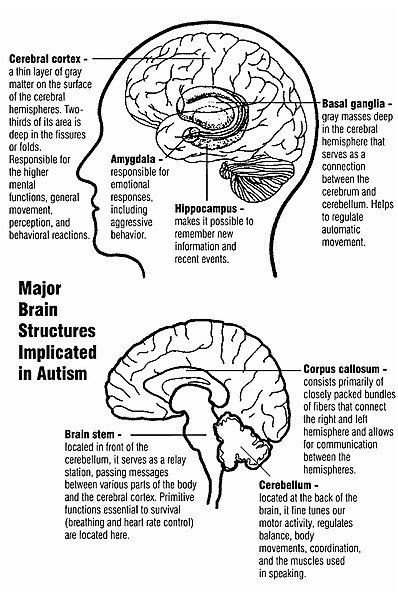
Neuroanatomical studies and the associations with teratogens strongly suggest that autism alters brain development soon after conception. There appears to be overgrowth of the brains of Autistic children just after birth, this is followed by normal or slower growth during childhood; it needs pointing out that this overgrowth may not occur is all autistic children. It seems to be most prominent in brain areas underlying the development of higher cognitive specialization, possible causes for this are; Autism is such a complex condition, one I can't do justice for in one blogpost! (I'm off to a homecoming party, promise my next post will carry on from this and will cover Asperger's next time too!)

Further information can be found at;
http://www.nas.org.uk/
http://www.nimh.nih.gov/health/publications/autism/complete-index.shtml

http://hcd2.bupa.co.uk/fact_sheets/html/autism.html
http://www.worldautismawarenessday.org/site/c.egLMI2ODKpF/b.3917065/k.BE58/Home.htm

Tuesday, 30 March 2010

Four Days = Different Outlook

Hello everyone!

Today's post is brought to you buy Help For Heroes! The reason for this is that I've just spent the past four days in Wales (one night in Neath, and the other nights at Haverfordwest), for my little brother's homecoming parade. He's in the signal squadron, this was first active tour of duty (6 months) in Afghanistan and has had many a near miss through it. Those left at home have been climbing the walls as bad news from the area he was in was broadcast on the news, even though we knew should something have happened we'd be the first to know. The family environment was tense, returning home day after day was proving trying and the temptation to work long hours crept in. I'm pretty sure the family would have shattered if he had been away for longer, and that would just have been my mother driving us away with her dark moods.

Yesterday we got to see him march in the homecoming parade, it was raining, it was dank, the band were playing ABBA (my brother will now be forever named "Dancing Queen"), and there were so many people that eyes were in danger of becoming victims to umbrellas. But, we stood tall, we stood together, we clapped, we cheered, we cried. I shared my umbrella with a young lady and her small son, celebrating the safe return of husband and father. We were celebrating the safe return of son and brother. We all shared a common interest. Well all shared pride. Overwhelming pride for those returned safe. They halted, each approached by the mayor, each given their prized medals, and cheered further. As heroes deserve to be!

We met them all for a beer, we hugged my brother, losing all anxiety. We laughed, we joked, we heard tales of war.....and then something happened that tested my theory of no pure altruism. These young men had been fighting, risking their lives on a daily basis, home for merely a day or so. My brother introduced me to one of his colleagues, one of his friends, who proceeded to hand over £20 ...... sponsorship for my 10k run in May, "to help raise awareness". £20 for the Alzheimer's Society.

My first sponsor.