Good afternoon everyone,
Today I thought it would be rather apt to talk about Autism seen as April 2nd 2010 is known as World Autism Awareness Day, on December 18th 2007 the United Nations General Assembly adopted resolution 62/139 (State of Qatar) making it thus. So, I shall start this blogpost by asking the question - What is Autism?
The definition of Autism is a"disorder of neural development characterized by impaired social interaction and communication and by restrictive repetitative behaviour". It is categorised as a Pervasive Developmental Disorder, the five disorders which fall into this category are as follows;
- Pervasive developmental disorder not otherwise specified (PDD-NOS) which includes atypical autism
- Autism, the best-known
- Asperger syndrome
- Rett syndrome
- Childhood disintegrative disorder (CDD).
Communication problems associated with PDD usually include;
- Difficulty using and understanding language
- Difficulty relating to people, objects, and events; for example, lack of eye contact or pointing behavior
- Unusual play with toys and other objects
- Difficulty with changes in routine or familiar surroundings
- Repetitive body movements or behavior patterns, such as hand flapping, hair twirling, foot tapping, or more complex movements
- difficulty with social communication; they have a very literal understanding of language (verbal and non-verbal), and thus believe that what people say is always the truth which makes slang, jokes, sarcasm and facial expression to be particularly difficult for them to comprehend. Following on from the spectrum concept communication may be different for each person, some may have full comprehension of what is being said to them but prefer to use non-verbal communication for response (e.g. sign language), whereas others may have excellent verbal skills but limited comprehension and thus resort to echolalia, or talking about themselves for long periods.
- difficulty with social interaction; People with Autism usually have difficulty comprehending or recognising the emotional state of other people, and may have problems expressing their own emotions. Therefore they may;
- not understand the unwritten social rules which most of us pick up without thinking
- appear to be insensitive
- prefer to spend time alone rather than seeking out the company of other people
- not seek comfort from other people
- appear to behave 'strangely' or inappropriately, as it is not always easy for them to express feelings, emotions or needs.
- difficulty with social imagination; People with Autism find social imagination difficult and therefore can not understand or predict another person's behaiour, these difficulties also apply to;
- predicting what will happen next, or what could happen next
- understanding the concept of danger
- engaging in imaginative play and activities
- preparing for change and plan for the future
- coping in new or unfamiliar situations.
- This should not be confused with a lack of imagination!
- Stereotypy is repetitive movement, such as hand flapping, making sounds, head rolling, or body rocking.
- Compulsive behavior is intended and appears to follow rules, such as arranging objects in stacks or lines.
- Sameness is resistance to change
- Ritualistic behavior involves an unvarying pattern of daily activities, such as an unchanging menu or a dressing ritual. This is closely associated with sameness and an independent validation has suggested combining the two factors.
- Restricted behavior is limited in focus, interest, or activity, such as preoccupation with a single television program, toy, or game.
- Self-injury includes movements that injure or can injure the person, such as eye poking, skin picking, hand biting, and head banging. A 2007 study reported that self-injury at some point affected about 30% of children with ASD
Autism affects how the nerve cells and their synapses connect and organise, which affects information processing. Autism has a strong genetic basis, and has beeen linked to rare gene mutations or rare combinations of common genetic variants, there is also the possibility of environmental causes (i.e. vaccines, heavy metals, pesticides). It's symptoms initially cause concern for parents as the child reaches two to three years of age as the signs gradually make themselves known.
The concept of the childhood vaccines being linked to Autism is quite controversial. Medical evidence suggests that there is no significant risk from vaccines, this is according to the American Academy of Pediatrics, the CDC, the World Health Organization, and the Institute of Medicine. This article by WebMD makes for very interesting reading with regards to this highly controversial subject.
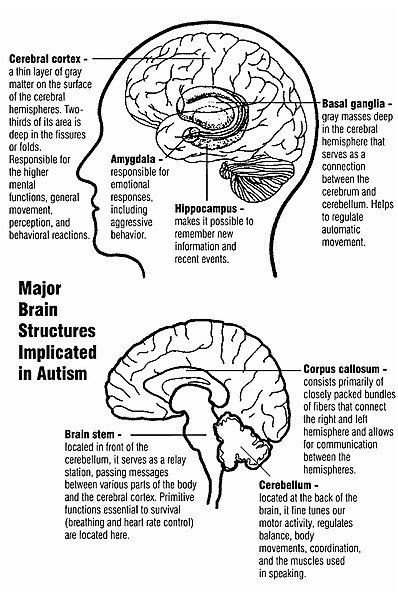
Neuroanatomical studies and the associations with teratogens strongly suggest that autism alters brain development soon after conception. There appears to be overgrowth of the brains of Autistic children just after birth, this is followed by normal or slower growth during childhood; it needs pointing out that this overgrowth may not occur is all autistic children. It seems to be most prominent in brain areas underlying the development of higher cognitive specialization, possible causes for this are;
- An excess of neurons that causes local overconnectivity in key brain regions.
- Disturbed neuronal migration during early gestation.
- Unbalanced excitatory–inhibitory networks.
- Abnormal formation of synapses and dendritic spines or by poorly regulated synthesis of synaptic protein.Disrupted synaptic development may also contribute to epilepsy, which may explain why the two conditions are associated.
Further information can be found at;
http://www.nas.org.uk/
http://www.nimh.nih.gov/health/publications/autism/complete-index.shtml
http://hcd2.bupa.co.uk/fact_sheets/html/autism.html
http://www.worldautismawarenessday.org/site/c.egLMI2ODKpF/b.3917065/k.BE58/Home.htm


0 comments:
Post a Comment